
Watcher
See everything. Understand everything.
Intelligence supremacy. Gather the faint traces others overlook until the void gives up its coordinates.
The Dark Forest
"The universe is a dark forest. Every civilization is an armed hunter stalking through the trees like a ghost."
Darkling is an asynchronous multiplayer survival game set in a silent galaxy. You begin as a dim civilization clinging to a single star, small enough that the dark forest rarely looks twice. Grow your colonies, research technology, then creep outward with scouts and listening posts. Every signal you emit makes you easier to find. Discovery is mutual destruction.
If you've read The Dark Forest, you already know the rules. Inspired by Liu Cixin's Dark Forest theory from The Three-Body Problem trilogy, every mechanic, from cloaking your signal to launching anonymous photoid strikes, emerges from that one terrifying axiom: survival is never guaranteed, and communication is always a gamble. Darkling is what happens when you stop theorizing about the chains of suspicion and start living them.
You check in after a few hours away. Your colonies have been quietly harvesting energy while you slept. A probe you launched yesterday has returned: there's a civilization at the star you were watching. They don't know you found them. You don't know if someone else has found you. Now you choose: strike before they grow stronger, watch them in secret, or do nothing and hope they never look your way.
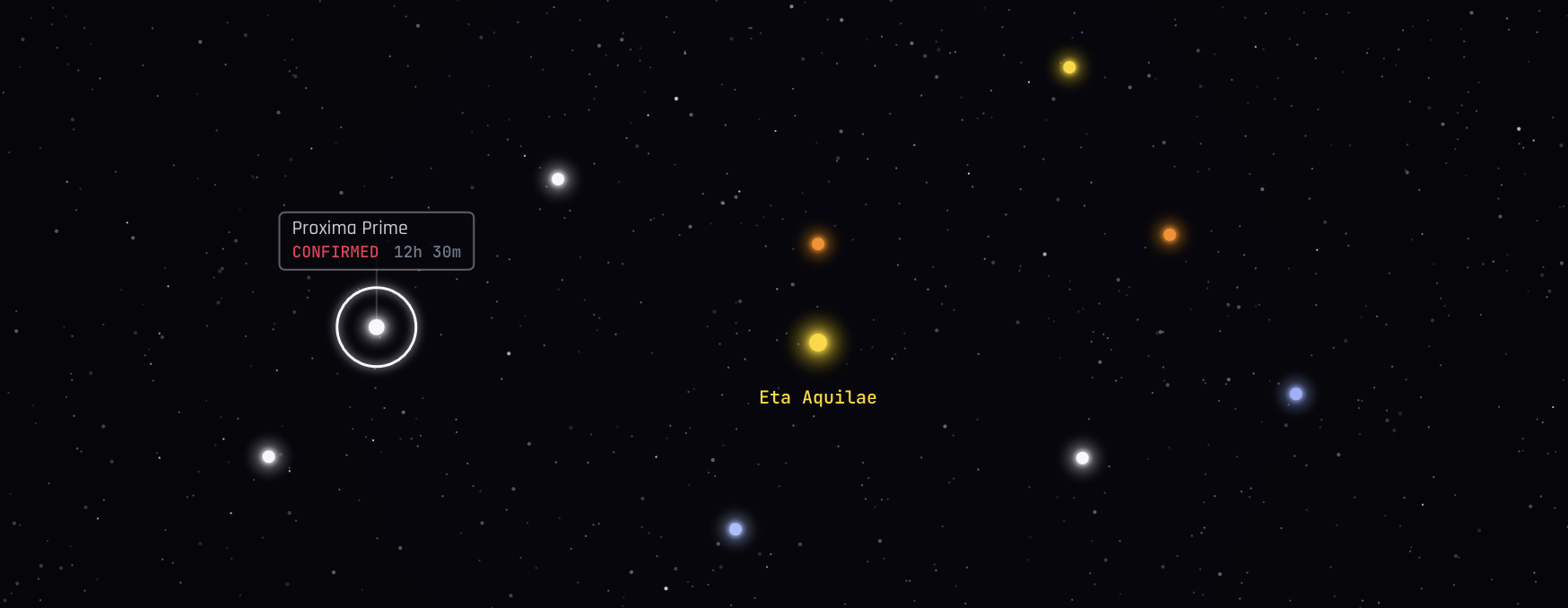
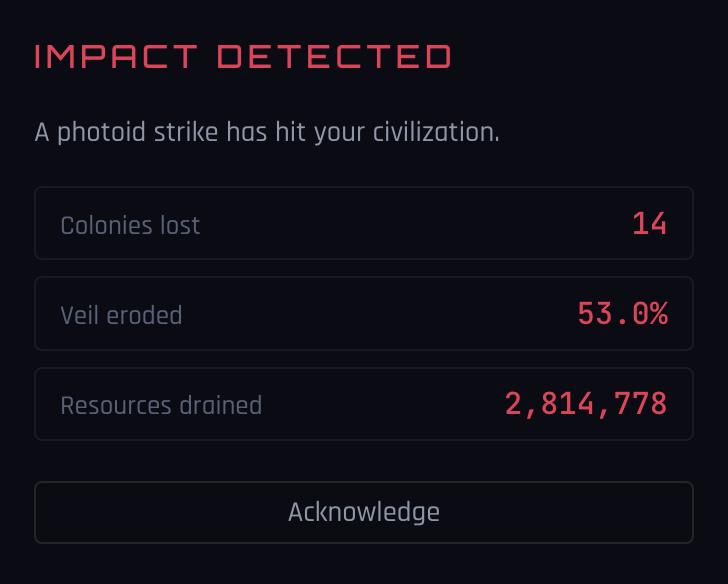
Launch anonymous dark forest strikes against known coordinates. Photoids destroy colonies, drain resources, and erode veils, but the attacker's identity stays hidden.
Send probes into distant systems to detect civilizations. But every scan risks detection. Advanced players may sense your intrusion and corrupt your intel.
Share coordinates with contacts, announce to the galaxy, or whisper anonymously. Every broadcast received could be a gift, or a trap.
Deploy signal-emitting devices at empty stars to create false readings. Enemy probes detect your decoy instead of empty space: misdirection as defense.
Plant silent sentinels at remote stars. Everything that moves through the galaxy leaves a wake (a probe, a scout, a photoid), and a single intercept can hand you a vector back to whoever sent it.
A quantum field that masks your electromagnetic signature, dressing your colonies as ordinary stellar noise or erasing them from sensors entirely. Raise it to vanish from the hunt, but a deeper veil asks more to sustain.
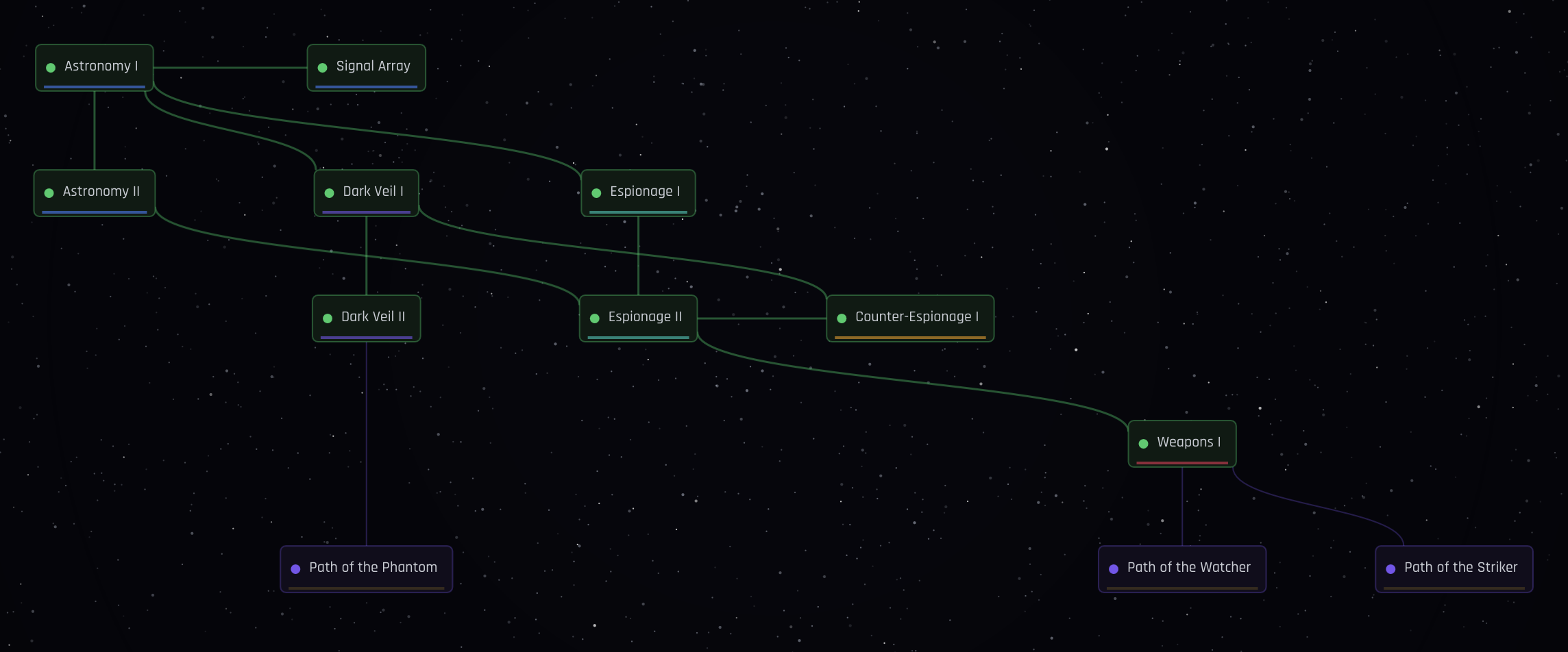
Observation, concealment, aggression: no single mind masters all three. As your civilization matures, you commit to one philosophy that defines how you survive the dark forest, unlocking capabilities the other paths can never touch.
See everything. Understand everything.
Intelligence supremacy. Gather the faint traces others overlook until the void gives up its coordinates.

Become the shadow itself.
Stealth and deception. Fade past every sensor, then leave false trails for hunters to chase.

Strike hard from the darkness.
Offensive supremacy. See them first and end them first: concealment becomes a firing position.
The galaxy punishes the loud. Expand too quickly, probe too aggressively, or broadcast carelessly, and someone will find you in the dark.
A contact shares coordinates with you. Are they helping you, or feeding you to a hunter? Every alliance, every broadcast, every shared signal carries a question you can never fully answer: what do they really want?
Every player sees a different galaxy. You never know how many civilizations exist, who has detected you, or whether shared coordinates lead to allies, or ambushes.
Civilizations are already out there: hiding, watching, striking. Join the community to share strategies, stories, and signals from the void.
r/darklinggameSomewhere in the galaxy, civilizations are watching. They've already seen you, or they soon will. The question isn't whether you'll be found. It's whether you'll see them first.